
One Battle After Another: A Review
Is that a gun in your pocket or are you just happy to see me?
By Tino Hluyo · · 12 min read
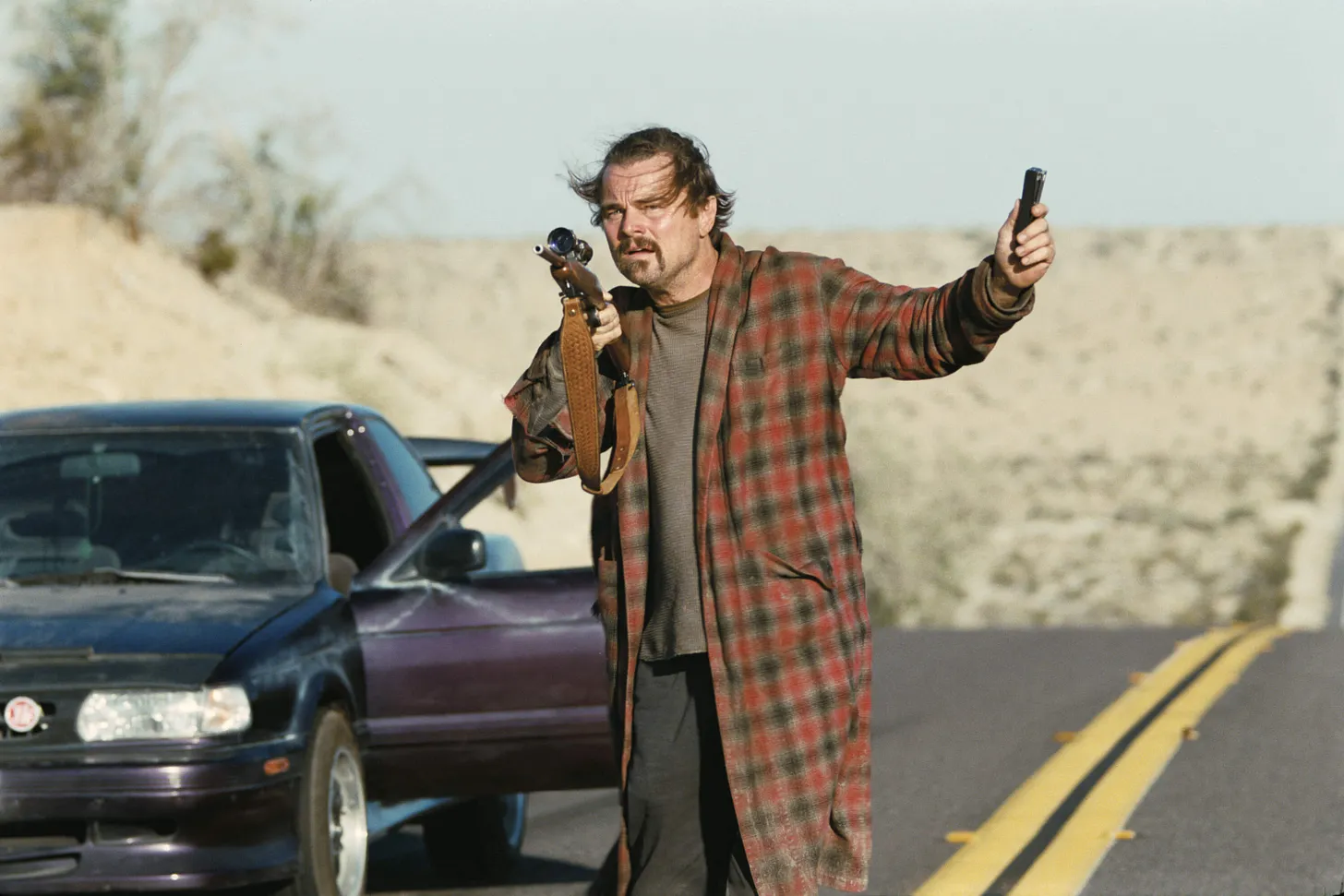
Synopsis: Pat Calhoun (Leonardo DiCaprio), a single father now in hiding after his activities within the “French 75” freedom-fighter group, has to step back into conflict after his daughter (Chase Infiniti) is kidnapped by a corrupt military officer (Sean Penn)— a figure with old ties to Pat’s ex-wife (Teyana Taylor) trying to tie up loose ends).
There are three somewhat similar routes to categorize One Battle After Another, Paul Thomas Anderson’s post-revolutionary adaptation of Thomas Pynchon’s Vineland: as an adaptation of the aforementioned book, and how well it exudes the spirit of Pynchon’s creation; as a post-revolutionary portrait; and lastly as another offering from Paul Thomas Anderson, barricading the first two perspectives to look at what’s simply another output from our gargantuan Hollywood auteur.
A lot has been both said and written about OBAA, utilizing the first two perspectives—maybe too much, in fact, and that’s why we’re here— with any concrete take using the third being left for only a bunch of ardent cinephiles and Paul Thomas Anderson scholars to brandish. It’s easy to guess that that’s where I come in. This is in no way a declaration in confronting OBAA without acknowledging its treatment towards either spheres of leftist representation on film or the immense and grand status of Pynchon; in fact, my approach is used here to illuminate issues around both of those spheres which felt equally neglected once I walked out of Cinema 13 within the Waterfront’s top-floor Ster-Kinekor plaza.
Paul Thomas Anderson, being modern Hollywood’s rara avis who combined his conversant cinematic knowledge, raw artistic instinct and the inherent privilege with being the child of a well-respected median personality central within the Media Mecca that is the city of Los Angeles, all at a very early age (with his debut feature Hard Eight hitting festivals while he was still 26), has used what one would undermine by calling an advantageous position to utilize the most wide open space and time possible to hone his craft into a distilled style. One that’s easily identified (or at least felt) watching just one scene within his ten film filmography.
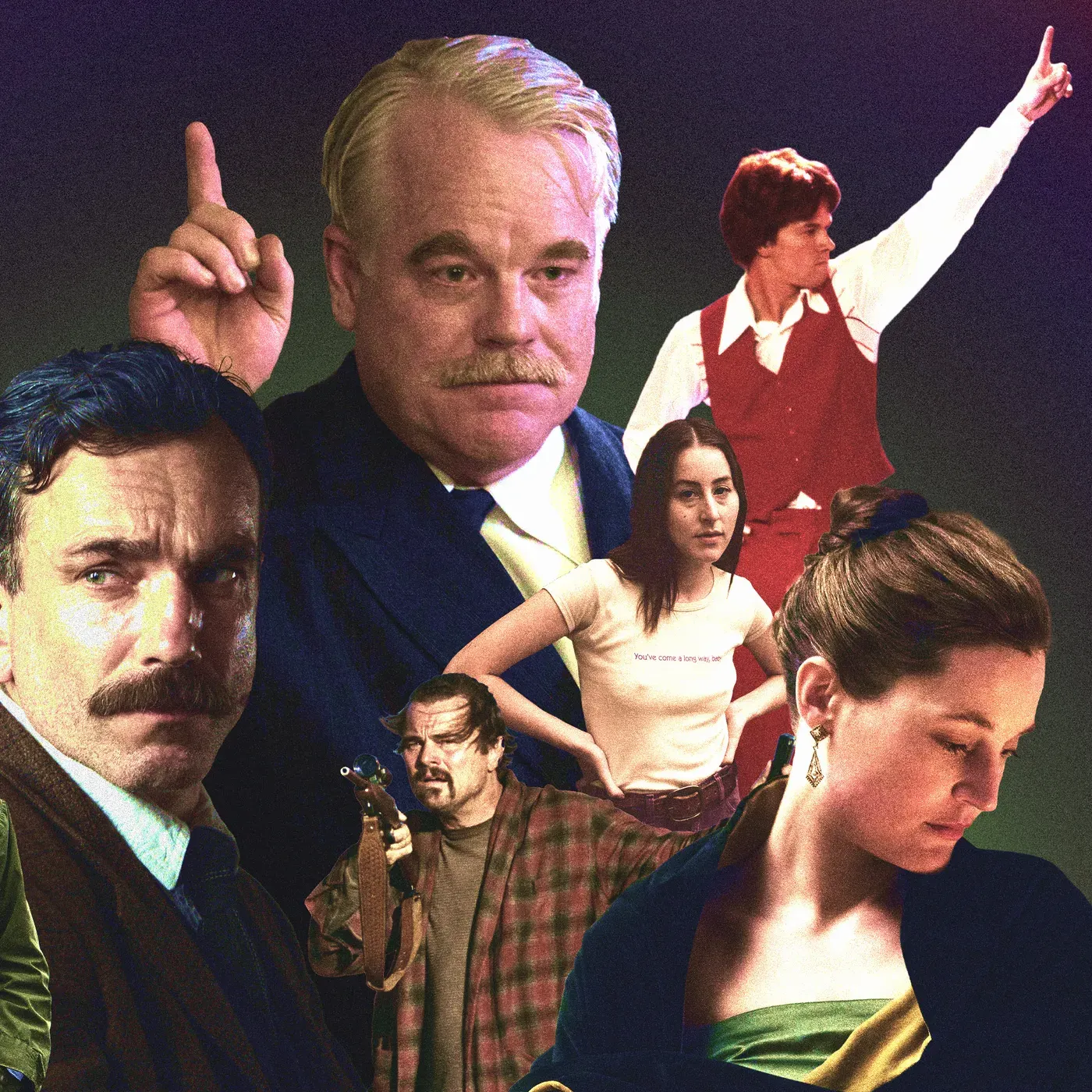
Boogie Nights (1997) and Magnolia (1999) established him as an in-tune puppeteer of chaos, freneticism and sprawling, familial relations almost always disarming even if you have trouble relating to them. Later on, films like There Will Be Blood (2007), The Master (2012) and Licorice Pizza (2021) diluted his relations between characters into something interpersonal, mutual and reciprocal. Within these one-to-one relationships, a more self-destructive and self-sabotaging nature comes about, where his two main characters constantly prove themselves to have no healthy use for each other (and, tragically, don’t even seem to have much good benefit towards their inward well-being), aided by a filmmaking style which took a slight turn away from PTA’s early free-willing energy to something more cerebral, carried along a rapid feeling of unease (with much help from his constant collaborator, composer Johnny Greenwood, who’s worked with him since There Will Be Blood). All throughout this time, constant eruptions of praise and awards have graced the storied filmmaker with what I’d admit as an enviable level of consistency.
It wouldn’t be responsible to say he’s “perfected” his style, but it’s not hard to tell that he knows, by now, what makes his films tick. How they present towards an audience outside of himself and which parts of his style (which almost always means which parts of his own self) are most welcomed and treasured by the most general and non-specific audiences…
Which is why it’s all the more perplexing and honestly idiotic he chose to make this thing in the first place.
One Battle After Another, a fine and well crafted film with barely any faults concerning matters of its form, gives us as an audience the privilege of watching two films wrapped in one: one part it so clearly does not want to be, with the other at least justifying itself sternly (it takes up over 3/4’s of the film as a whole, so it has some free reign to accomplish this) but still falling flat due the looming presence of the former.
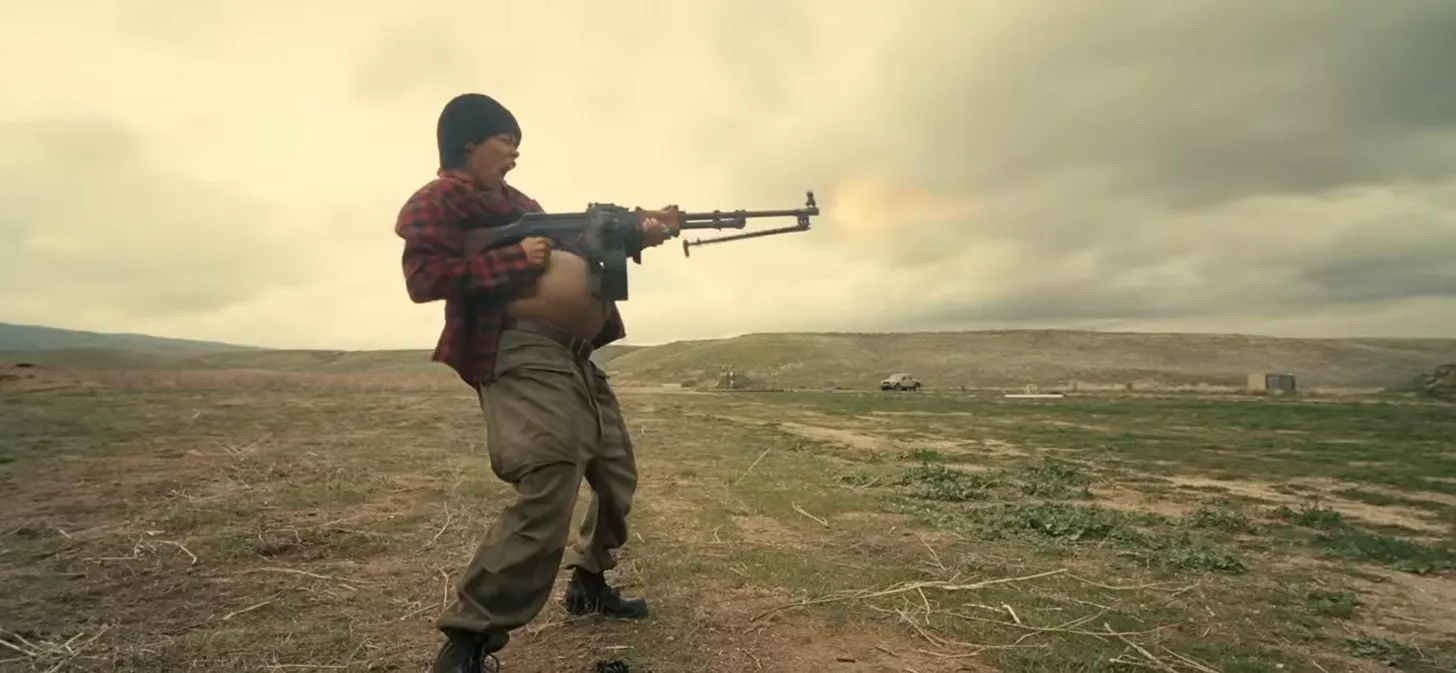
The first part, the film’s 30-minute prologue which follows Pat, his lover Perfidia and the rest of the French 75 executing daring capers, bank heists and rescue missions inside immigrant concentration camps, is the part I have no confidence in saying PTA really wanted to tackle on any level, besides that of style and reintroducing the audience an assertion that he’s a very well-exercised filmmaker. The idiosyncratic, pulpy dialogue which PTA is known for makes itself known from the get-go, and for the first time in his career this comes to a detriment. The script just can’t help to paint the French 75 (a guerilla group consisting msotly of African-Americans save for Pat and a few others) as rabid caricatures of revolutionaries, wholly failing to ignore so many personal and psychological factors which push these types of outspoken activists towards their acts of rebellion in the first place (in other words, it misdiagnoses what actually makes a radical).
Paul Thomas Anderson is not a political filmmaker. As stated before, his focus is and always has been on unconventional bonds between characters, sometimes good for each other, sometimes not. The French 75 serves a purpose not too different from that of the faux-family in Boogie Nights, who encourage each other to live wholly and passionately as their own free selves (with the distinction that Boogie Night’s porn cohort in Boogie Nights are together in some hope to “make it” in their industry, while the 75 march together towards a much more worldly goal). Problem is, his zany but more importantly humanistic approach to outsider families within his dialogue comes off as only zany between the 75. His freedom fighters come off as performative teenagers, enticed by the thrill of “rebelling” rather than the communal reverence of “rebellion”.
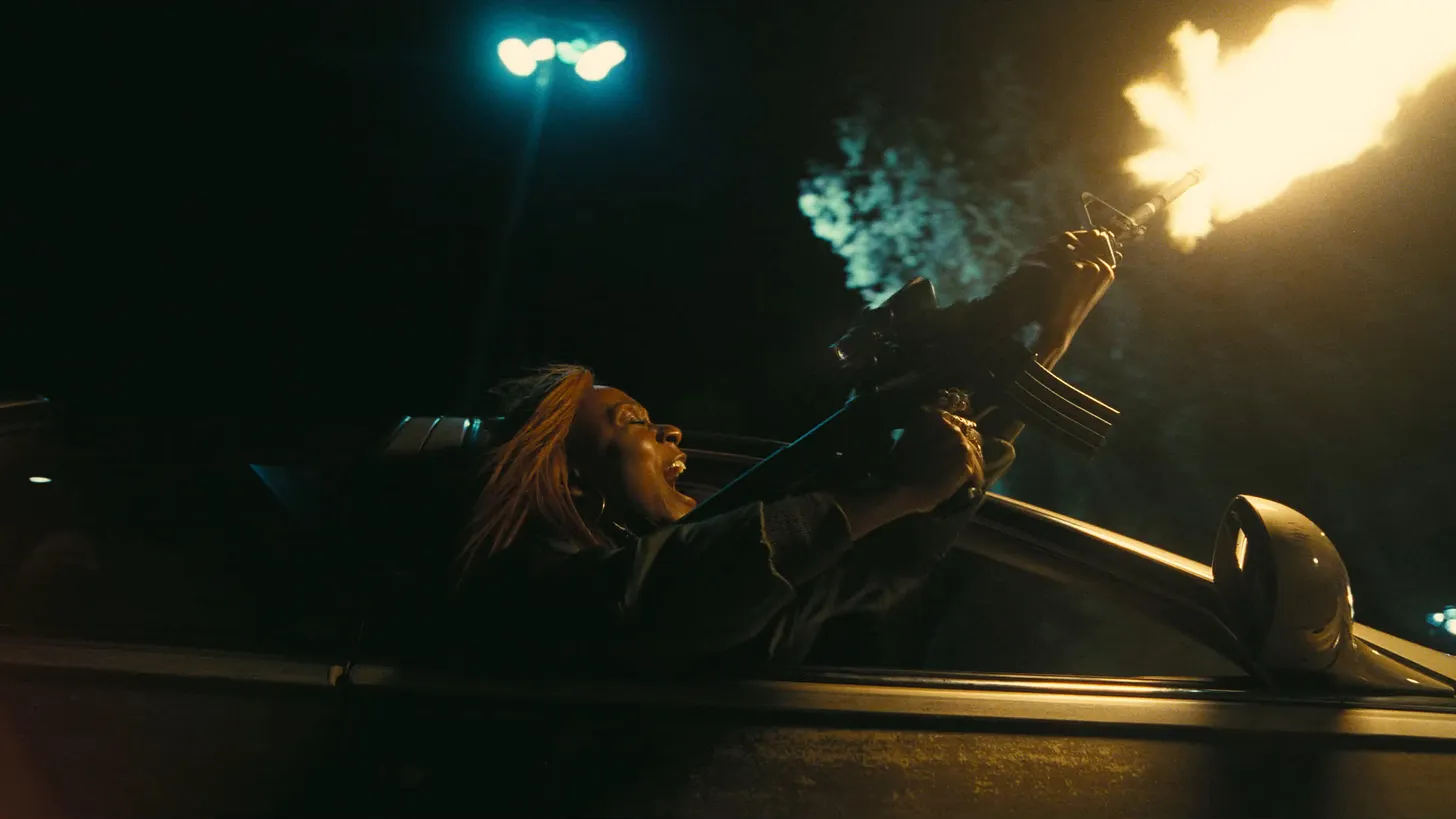
The men (Dicaprio’s “Pat” and Wood Harris’ “Laredo”) are preoccupied with the interracial fantasy they’ve found themselves within as a part of a diverse, energized militant group filled with outspoken, “dangerous” women which they can’t help but salivate over as exotic flames brought to them over an invisible racial divide.
Perfidia: “You think he likes black girls?”
Pat: “Of course I like black girls! That’s why I’m here!”
Laredo also says something about his “crazy white girl” which I can’t directly quote, but you can take my word that his sights on bunny-hopping are equal to and if not, higher than that of revolution.
The women in the French 75 fare no better. Characters such as Perfidia and Junglepussy (played by the musical artist with the same moniker) seek power and long awaited affirmation through their acts within the group, power that is subtracted from them multiple times over due to their circumstances as black women in America. Their wants, on paper, could still make for a thrilling ensemble; how limiting and false it would be for Hollywood representations of black female activism to only hold noble examples, denying the full spectrum humanity holds, even while in constant subjugation? The issue comes about when, after watching their exploits for an adequate amount of time, it’s made clear these women hold only these desires, with no prospect for actual liberation or a concrete future for them and the women who will eventually follow. Perfidia, at the end of the day, just gets really horny at hanging on danger’s edge, barely able to help herself while Pat shows her how to make a bomb. While it’s noted that she comes from a long line of revolutionaries, this only polishes and illuminates the frustrating truth of her not really caring for revolution. After her flings with both Pat and the military officer Lockjaw (Sean Penn), she makes quick to rat out the 75 for her own preservation, her true goal hidden deep within her explosive exploits.
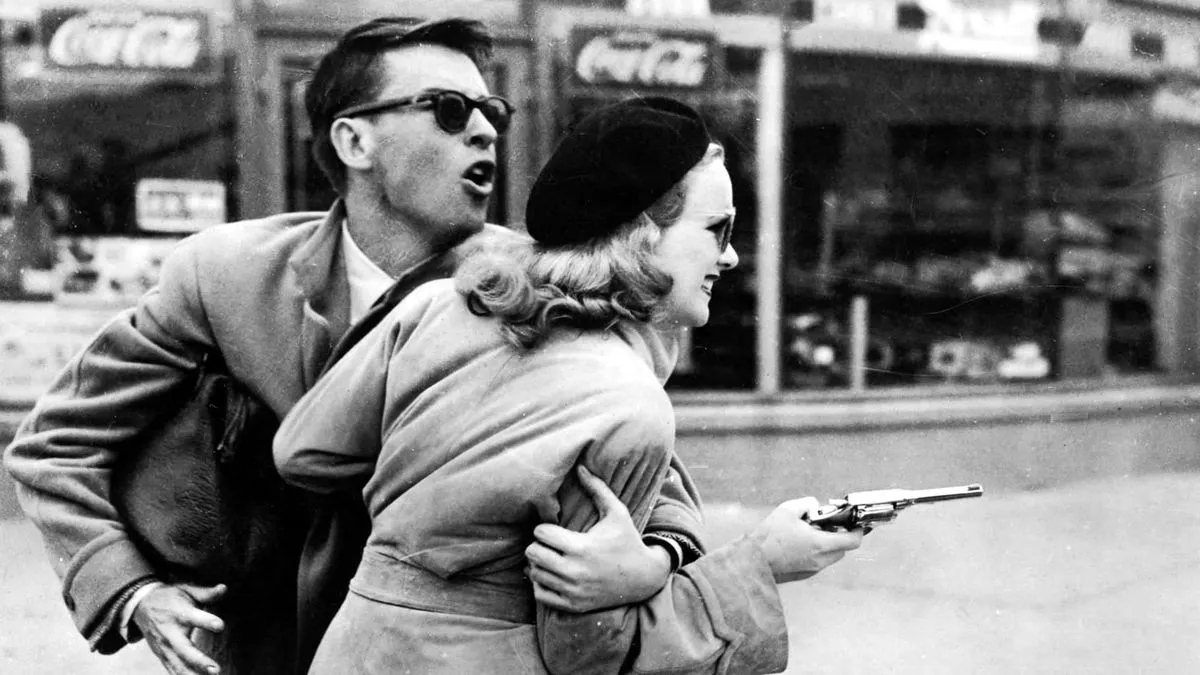
It would be very easy to compare the French 75 to Bonnie and Clyde and all their copycats; rebels whose lust strengthens while on the run; but it would be more accurate (and less accessible) to compare them to the provocative couple in Joseph H. Lewis’ Gun Crazy (1950) (a film I love so much I’ll use any excuse to promote it), who brandish a more direct, psycho-sexual tie to the act of handling and firing weapons (they fuck, with firearms; all harassment brought down by the law is added tax they find no pleasure in). I will repeat myself, such an approach towards activist groups as juvenile and slightly condescending as this can still be useful for good drama (and at times it exudes just that), though Anderson’s execution leaves you with nothing to feel about these characters besides ambivalence (at best) and/or annoyance (at worst).
The second film embedded within One Battle After Another (which PTA had much more enthusiasm in exploring) is that of a domestic father-daughter drama, taken to sweeping, cross-country proportions through its large-scale action set pieces between Pat, Lockjaw and Pat’s grown up daughter, Charlene (using the name Willa for matters of safety).
Almost two decades after the film’s prologue, the setting has moved to Pat’s new home (with his new name, Bob Ferguson) in a small sanctuary city where Pat lies dormant as a paranoid, pot-smoking bum so controlling and high-strung he won’t let his daughter use a mobile phone. While it benefits from PTA’s off-center and ever purposeful style of filmmaking, the largest chunk of OBAA is, at its core, not that different from many sentimental, coming-of-age dramas where the irritable baby bird of the family begs to soar high and far away from the oppressive nest of its narrow-minded though widely-experienced parents (their lives have taken the shape of a gargantuan, ominous cone).
There hasn’t been an Anderson film, from my perspective, that has taken on a dramatic structure as run-off-the-mill as this; even Licorice Pizza, the director’s one and only proper coming-of-age film (and my least favourite of all of his pictures) moves through a more daring collection of moments and experiences for his young protagonists. It’s a frustrating experience to watch Pat go through the motions of your average out-of-the-loop movie dad; intimidating a nice young man at his front door eager to take Willa out to the high school dance, Pat trying and failing to take a selfie on his smart-phone while Willa looks on with aw-shucks understanding, his bumbling confusion over pronouns and non-binary classmates. Endlessly grabbing onto low-hanging fruit, done without shame by an inventive filmmaker such as Anderson, that comes off to me as embarrassingly hesitant. The relation between Pat and Willa, which obviously needs mending as the duty of family begs of it, is only written, performed and shot, but never felt.
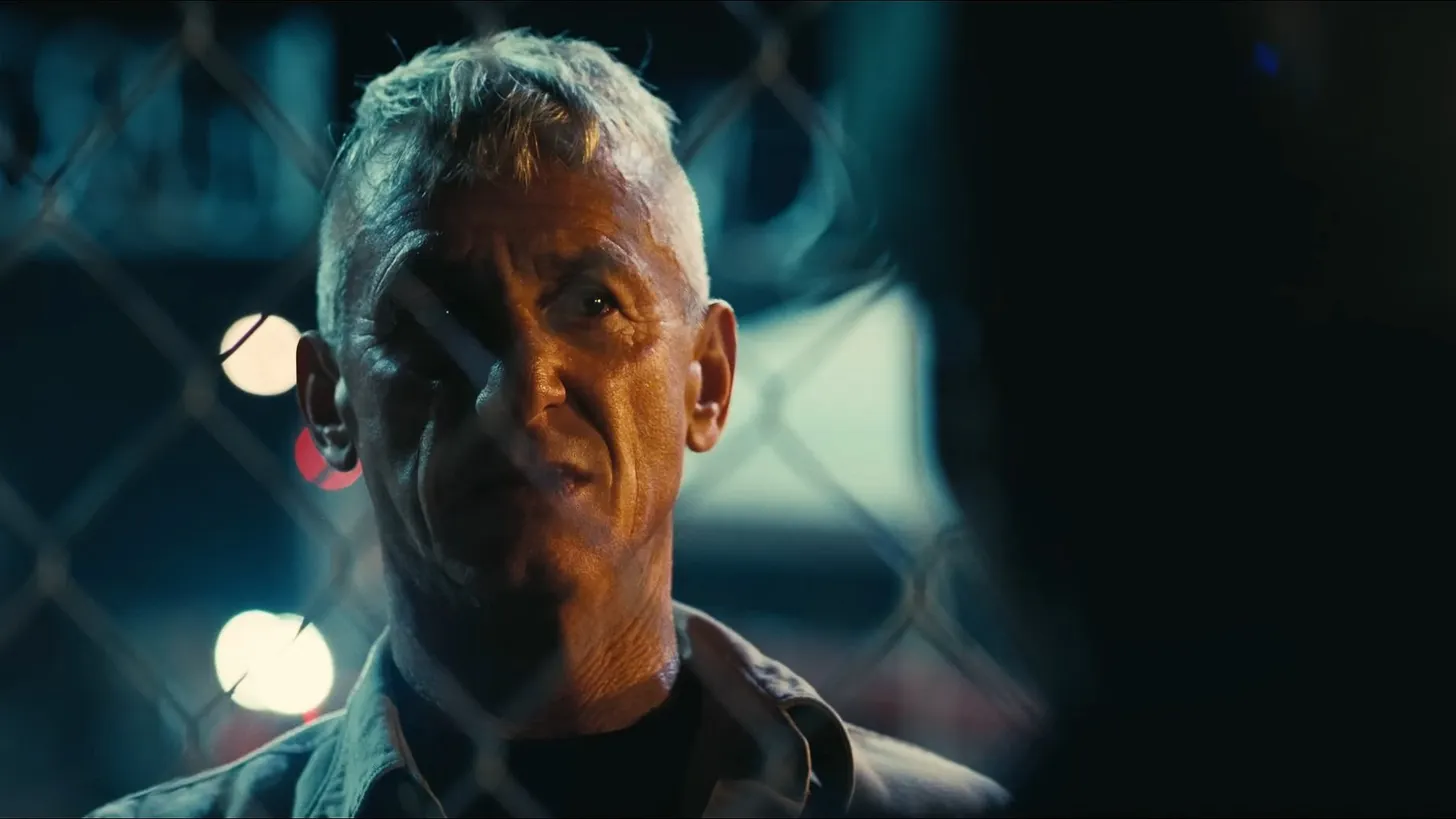
The film benefits greatly from Sean Penn as Steven Lockjaw—that is to say, both Penn’s performance and Lockjaw’s motivations are both brilliantly handled—who took me for a wild surprise upon witnessing the greatest Robert F. Kennedy Jr. impression ever performed (and I am more than 50% sure said impression was not planned at all); his role solidifies the otherwise rarely felt Pynchon air that, without him, would have me doubting if PTA wanted to really adapt the author’s work in the first place. His presence can be described as the scariest Looney Tunes villain you’ll ever see; a caricature of hyper-artificial masculinity riding proudly as the horse in front of one’s psychosexual need for chaste humiliation and suffering which nears the castration of his own superego.
His desire for Perfidia cannot even attempt to hide itself as a niche fetish compared to all the bunny-hopping within the 75. And I’m not shy to say it works much better through his character than through Pat or Laredo, due to the fact his lust for black women paints a much more interesting psychological portrait. His fetish for black women isn’t even truly one for blackness, but for humiliation. He loves being dominated as a continuous practice, even loving the idea of joining the Christmas Adventurer’s Club (the film’s secret white supremacist society) as a loyal subordinate. Similarly, he loves being dominated by Perfidia, as the taboo of being humiliated by a black woman particularly grants all him all the more excitement. His character is undoubtedly slimy, repugnant and embarrassing, and you can’t help but to keep watching this white man receive further and further ignominy. Even his bulky Popeye’s walking style had me cracking in the cinema. If only the rest of the film honed in on this brand of weirdness and unusual social commentary through niche psychological portraits.
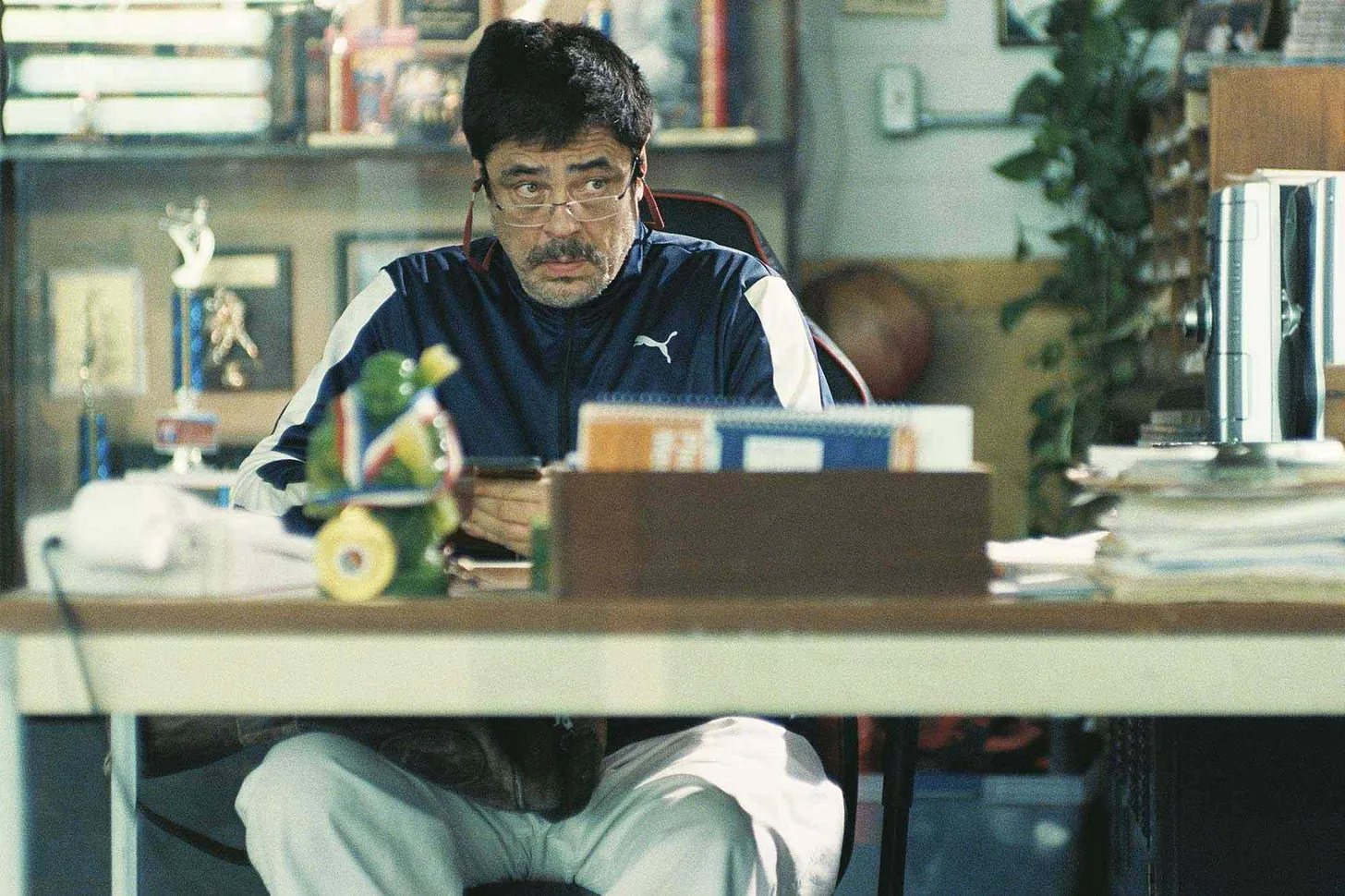
Benicio del Toro’s turn as Sergio St. Carlos, the leader of undocumented immigrants in the film’s sanctuary city, is equally as enjoyable. The film’s prolonged sequence where we follow him and his group’s organized efforts to shepherd safely each immigrant through a rumbling city kept awake through an unending street-level protest (which gets provoked into a full-scale riot) was extremely dynamic and gave me stark, strong reminders that PTA can still direct scenes with charming, frantic uniqueness when he really wants to. This segment also grants some space for forgiveness onto the film’s prologue, hinting that PTA only meant to paint the French 75 as naive and self-centered, and not all revolutionary activity as a whole.
Much has already been said on social media platforms about its winding car chase sequence—and I can’t say that much more, it’s hard for me to grant judgement on action besides the fact that it either sucks or rocks— and I can’t say that part of OBAA was anything refreshing or “mind-blowing”.
Over and over, I just kept thinking the film’s action sequence moved like a 40-minute set piece from Bill Hader’s Barry (2018-2023), which isn’t to call that bad company or to accuse PTA of some gross imitation (of course, it would be Hader that’s inspired heavily by Anderson). Yet, with prolonged silences, neo-western landscapes and a cynical fondness for underwhelming payoffs, the film’s climax can get as many flowers as it wants for its efficiency and contemporary sensibilities towards how action scenes should be shot and cut—at least for any genre film that wants to be considered high art, which we can mostly thank No Country For Old Men for (specifically when it comes to the 21st century resurgence of minimalist thrills, that is; one could look all the way back to the films of Jean-Pierre Melville and then further back towards Lang’s M (1931) for a true diagnosis on surgical action set-pieces).
Its ending leaves so much to desire, so much so that another article can be written on that alone. I’ve heard arguments that the script was obviously cut down mercilessly in the editing room, though even if it was it doesn’t excuse every issue I had with the film that comes down to a much deeper, non-formalist issue I had with One Battle After Another: I still cannot, after three days of internalizing what I saw, see why Paul Thomas Anderson wanted to make this in the first place. With every piece by him that has come before, I can see the get, and that is because it makes itself visible to me without shame or hesitance. Here, I see no true attachment or get in his depiction of revolutionary life, contemporary America, the bonds between those always on the far edge, or even (and this is what disappointed me the most) what it means to be a father.
Enjoyed yourself? Well, even if you didn’t, make sure to like and restack this post as it gives us all the more motivation to come through with another post. For everything cinema related, make sure to subscribe to 24th Frame Film Club (and we’ll see you at our weekly Tuesday film nights)!