
a short review/recap of The Underground Railroad by Colson Whitehead
By Tino Hluyo · · 5 min read
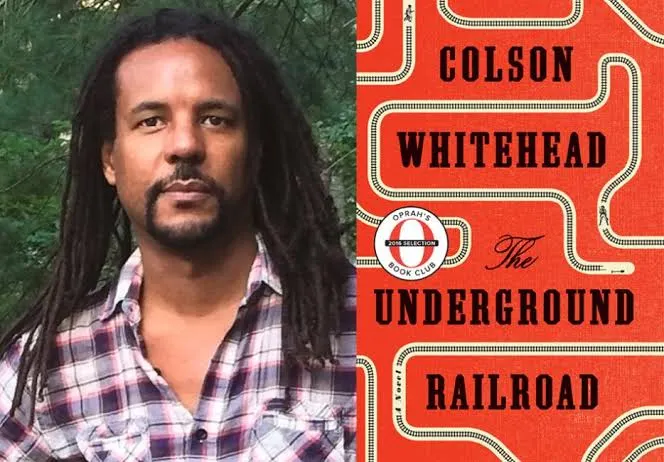
There's no way to explain how hard it is to review this one. What troubles me is my decent but still loose grasp in reviewing literature compared to film (as I've never done that before). On the other hand, this novel certainly had a strong grasp on me.
I’ll pinpoint every thought I had while reading it in a concise but considerate manner. Within the first 10 pages I could easily figure how this book won the Pulitzer Prize for Fiction (on its prose and skill alone). Of course, Pulitzer winners never become so based on skill alone; its impact on either its artistic or general zeitgeist holds it in place.
That part will be explained later. With a subject as horrific as slavery this novel had an almost automatic effect that would fall over anyone with a sympathetic eye, but what makes it unique is its immediate focus on hope as a force that both sustains and destroys our protagonist (a young woman named Cora) and the women who came before her: her grandmother and mother.
Cora comes from a line of survivors, but the charred hand of slavery holds its victims in a fate far worse than death. Her perseverance is not merely hereditary but an evolution of her grandmother's, who survived with all her might but still stayed a slave her whole life. Not to spoil anything (as the book's title very heavily implies this) but our protagonist finds the unstoppable force of her grit as something useful for the chance of escaping slavery and joining countless other runaways, as a part of the Underground Railroad.

Everything before the point of her devising an escape reminded me of a clip of director Michel Haneke talking about the responsibilities of depicting historical tragedies.
What he said wasn't 100% agreeable but provides a launchpad for me to explain why everything after page 50 is, plainly put, perfect. Talking about Spielberg's “Schindler's List”, Haneke describes it accommodation for entertainment (specifically the gas shower scene in which the Jewish prisoners don't know whether these showers will produce gas or water) as "unspeakable".
But how is such a harrowing scene entertaining? If anything, it brings the audience grief and little solace, but the true definition of entertainment hasn't truly been found its own consensus. Entertainment could mean the persuasion of an audience to any strong emotion: joy, excitement, terror and even sadness, at least that what it seems to Haneke.
With that stance, portraying a true and tragic tale in a manner that amplifies its tragedy is still entertainment, though wouldn't it be inherently tragic either way? I think art is inherently persuasive, the mere presentation of a piece persuades the audience to focus on whatever subject matter it's involved in. But hey, that’s something to talk about another day.
That's what came to me while reading The Underground Railroad. I realized later in the novel, when its main story begins, that it is not a festival of tragedies, a gallery of black pain that lacks historical and perspective width. In fact, it's quite the opposite. This is the most historically broad and emotionally truthful book I've read in ages.
The Underground Railroad isn't a novel about slavery, it's a tale about America. With its subject matter it's obvious this book tackles the history of America. But not as an assortment of facts and events, but how things came to be. How America came to be. It has a branching view of history, refusing to hold a singular view of events and refuses more ardently that history is simply a force, washing over humanity through the train tracks of time.
Cora's antagonists surely do though, believing that the American Spirit simply led them to their era of terror over the African continent, the displacement of the native populations and all their other crimes. Everything about America is unnatural, quite the opposite of a worldly spirit or force.
While the White-American's history might be something hopeful and impressive akin to Forrest Gump, the African-American's history could not be more detached from that. Cora's journey succeeds in singing the songs of so many other Americans. While not a woman who really “existed”, her story was certainly lived, over and over again.
To name a few, it bellows the stories of the enslaved, slavers, runaways, abolitionists, slave-catchers, freemen, born-frees, the unknowingly sterilized, children of slave mothers and master fathers, the privilege of both planned and accidental nature, the seen and unseen agents of the Railroad and the slaves who escaped but realized their true prison was America as a whole.
There's a great moment in which a Railroad agent jokes that "if you want to see the true face of America, ride the Railroad". A joke; as the rails go underground, simply a dark void of rock and engine smoke.
There is no face to see when you first think of it, but in retrospect it was always right in front of you. America is a faceless, hidden visage, it's face ripped off by self-proclaimed pioneers and agents of an ungodly spirit. It's a void, empty of identity, Black, white or native.
America is only a perspective.
My one critique (which I don't even know if it is one) is its constant rendezvous into the bleak, a cold natural state it always returns to. With every period of hope, goodwill or success in Cora's journey, comes an interruption of heartless malice, gross misfortune.
By the third time this occurs you get the intention. No matter what turn of fortune, it will always bend back to a rigid line of servitude and scarcity when your kind roams a nation it was never designed for. Hell, this could even be applied today. For a person of colour in America and many other places, you can make vast pools of wealth, abide every law, uplift your own and every community your limits allow, you could even become the president of United States and the world will still remind you you never held the cards.
The common conservative narrative is that the progressive is a defeatist who finds no satisfaction in the runnings of the world, meanwhile their focus on the individual and one's ability to pull themselves up from the bootstraps is a virtue of hope.
I point that out because, much like the progressive, this book isn't set on telling you the world is permanently screwed and there's nothing to do about it; it points out that what's screwing it is a system-- a system that can be changed/dismantled but not as long as the majority abides and calls it just, or knows it's unjust and comforts their truth with frightened individualism-- as if one can abstain from the system while attempting to benefit from it.
Simply put, the book's blunt truth can be seen as a discomforting and monotone tune that not everyon will praise. The Great American Novel (an unofficial prize title given by an agreement of critics and readers) is defined by Wikipedia as a "novel that generally embodies and examines the essence and character of America".
It's coined to a few dozen but undeniably vital books: Huckleberry Finn, The Great Gatsby, Catcher In The Rye, Infinite Jest, the point is made. Despite it wining both the Pulitzer Prize and National Book Award, The Underground Railroad hasn't received enough in my eyes. It's time we deem it as the latest Great American Novel.