
Eddington, meet Eddington
World News has, unfortunately, ruined my film review.
By Tino Hluyo · · 9 min read

Spoilers for Eddington (2025)
It’s been two weeks since, within a secluded Rondebosch apartment with my astute friend Jamie, I watched a digital copy of Ari Aster’s post-lockdown satire Eddington. I liked it. Jamie, not as much, and without much explanation needed— though he granted me that anyways for an hour or two.
Eddington is stupid, though not brandishing the type of stupidity you’d relish in an off-the-cuff comedy or high-octane action film. It’s not stupid in the sense that it’s trying to brainless, it’s rather a stupid film for “smart” people.
It’s primary objective, both within its content and its disassociative, manic, brainrotten form (a second go at such a style for director Ari Aster, which he tried (in my opinion, with mostly disastrous results (though not in the way he wanted) and bland feelings afterwards) before with his film Beau Is Afraid) is to be stupid in a way that audience members who see themselves as potential Geiger counters with hands on the pulse of our zeitgeist would like to view as smart.
I am one of those audience members, unfortunately, in the sense that I would very much like to be assured that I can see some part of the tapestry so haphazardly stitched behind our current though constantly changing times. Anyone who possesses the shamelessness to start a Substack (or too much shame, and they see this site as a place to “make up” for something) sees themselves in this light this too. There is no doubt in mind that Eddington was made for overthinkers like us.
The film crawls along as an unbroken two-hour doomscroll in front of the viewer’s eyes. One nausea-inducing, numb rally between many unending states of tonal whiplash. Through one passive, unconscious flick between posts (especially on Twitter (yes, we’re deadnaming X) which Ari Aster has confessed to spending too way much time on too (any amount of time on it is way too much)) one might find themselves in the aftermath of an unbelievable, repugnant travesty and a crime against humanity which precedes any and all legislation— right after a silly (possibly AI-generated) short-form video spouting all sorts of brainrotten nonsense currently relevant to the algorithm (I won’t list any examples as they will probably find themselves outdated and irrelevant a few hours after I post this).
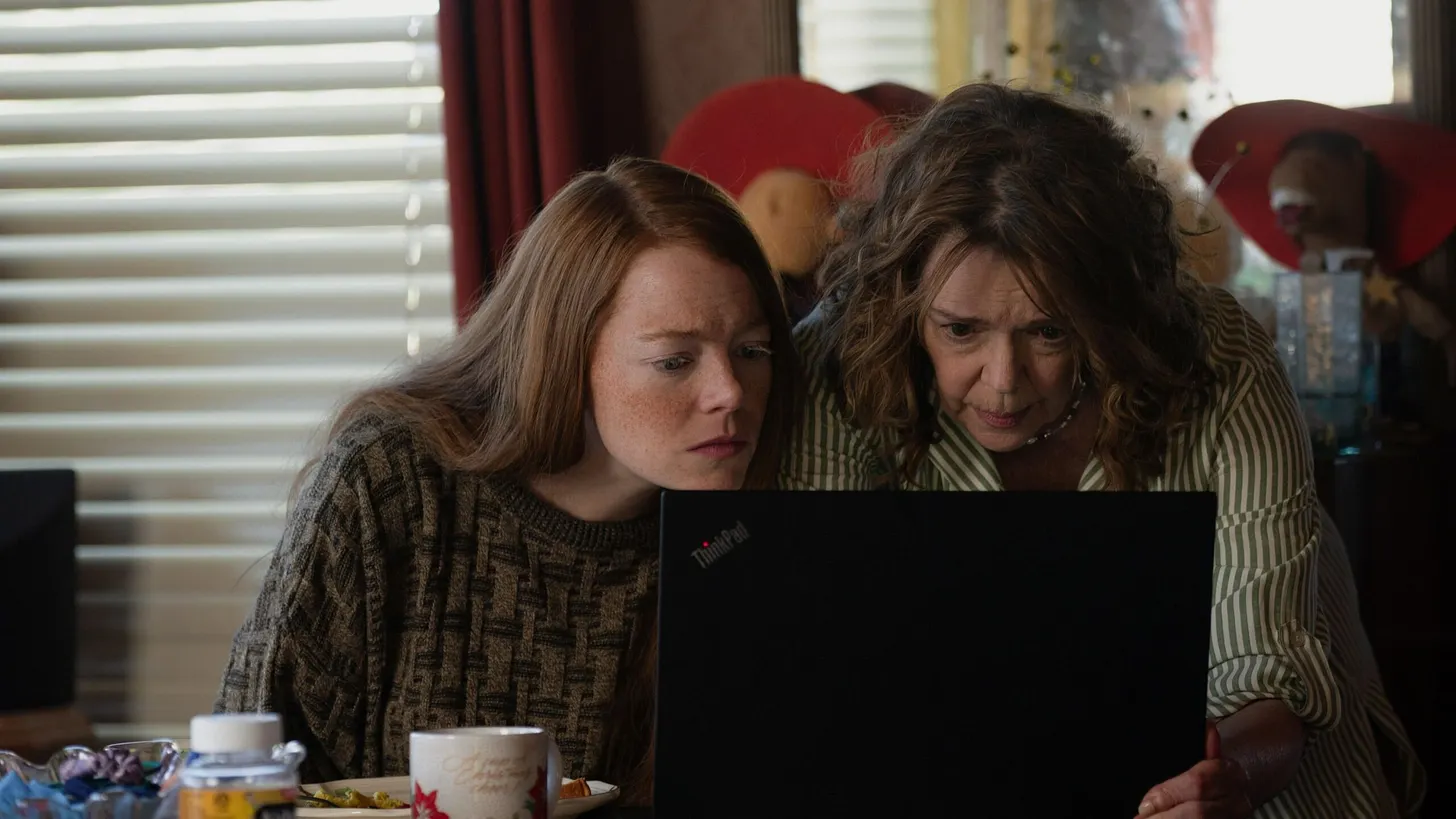
This is in some part the “stupidity” Eddington tries to investigate. Or, maybe, “investigate” would be a word that grants the film too many props. I enjoyed Eddington, but my experience watching it felt more like Aster presenting the weirdness of our modern times rather than investigating it.
Eddington takes place in a small, quirky Southern town mostly irrelevant to the larger mechanisms of the world, with its narrative focus placed on its well-known but not exactly popular sheriff Joe Cross (played oh so pathetically by Joaquin Phoenix) who holds strong disagreements and resentments with the mayor Ted Garcia (played by Pedro Pascal, who shows a new and surprisingly hard-edged hue in this role (he should play assholes more often)). Their feud has its fingers spread over many avenues and non-negotiable standards of what life should be for their community and themselves.
Joe is undoubtedly conservative. Worse yet, he’s the type of conservative who’ll never admit it (at least until the Overton Window shifts further rightwards to where calling yourself one grants automatic success mixed with social prestige (we are already seeing that happen in cases, hence why I stress “automatic”)). If anything, Joe and his kind self-identify with a stamp of virtue which prizes him as an “enlightened” one; he who is “above” politics. His demands such as the abstinence from taking COVID-19 vaccines (and vaccines in general) are not political demands to him at all. It’s everyone else who’s spoiling the village waterhole with ideology, identity politics and calls for Orwellian states of surveillance.

Ted is liberal, though not undoubtedly. That second part matters, but not too much in this particular discussion at hand. Yet, it’s important to note that Garcia is strongly written as the sort of smooth-talking, man-of-the-people politician who might even call himself a leftist on a good day (and amongst the right crowd), but at the end of the day (even the good ones) he is just a faux-partisan careerist. All leftists have at least one or two wounds which still need licking from past infatuations with liberals like Garcia, who seem dedicated to bringing back the Overton window to our side with an unassailable charisma and aura which would make every attempted reactionary takedown against him laughably fail and choke before arrival, not particularly because he always seems right, but because he always seems “normal”.
The distinction between these men matter not just for your own understanding of where they might be coming from, but because they (most importantly) don’t. Most conflict arises between parties who misunderstand each other or don’t understand each other or don’t want to understand each other (of course, someone can antagonize you while fully aware of your own humanity) but at least these parties usually understand themselves. Within their self-understanding (recognition might be a better term, as they are merely aware of what they are and what they want) they plant their feet at a particular, strategic spot on the ground.
Now, a man like Joe Cross might be aware at least of who he is: American, white, male, a member of the police force with all the privilege that comes with it. But one must really inquire into what he actually wants, and ask if he actually knows what he wants. After an argument with Garcia about whether Joe should wear a mask in public or not, he decides to run for mayor and races Ted out of his tiny throne. The only policy he even tries to articulate is a removal of the mask mandate (which is upheld by the state anyways, so it would be an uphill battle to fight if he were mayor), and he can’t even come up with a concrete running slogan.
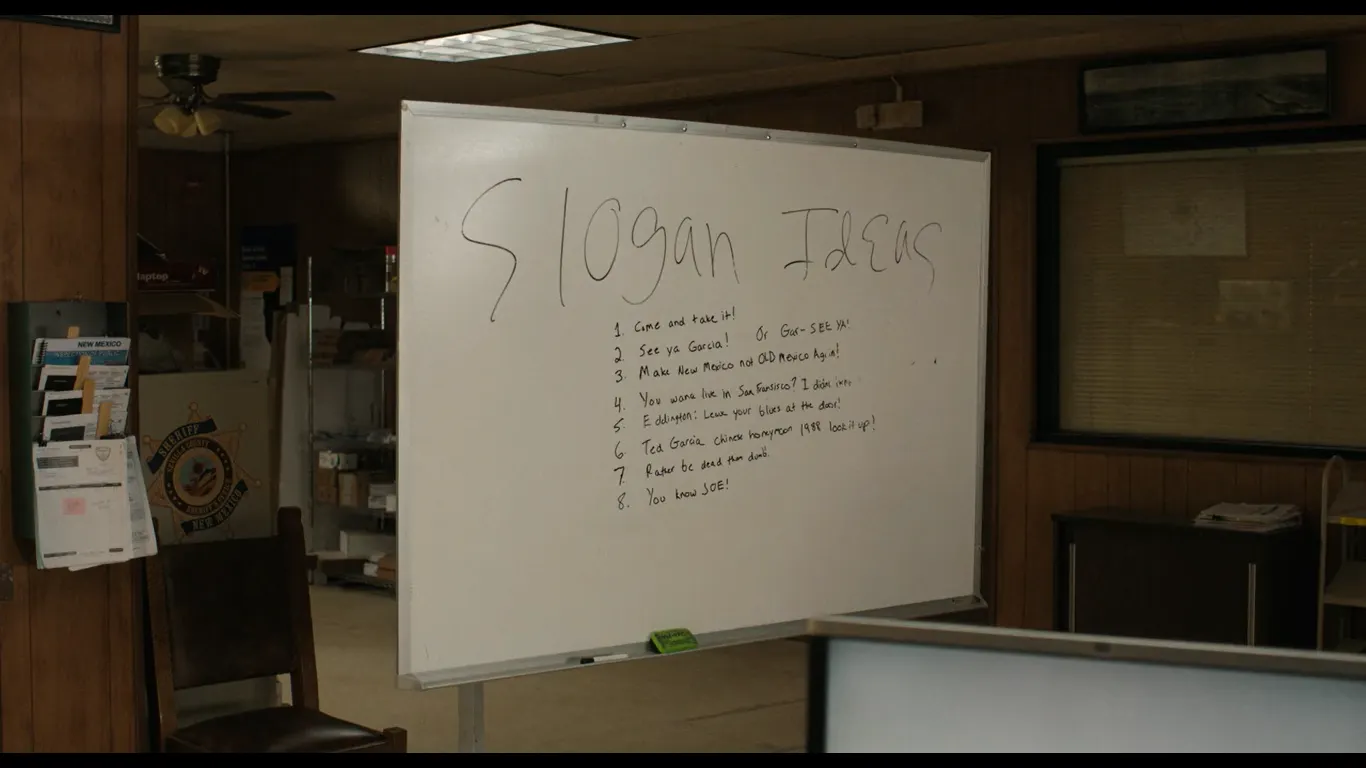
Joe’s politics aren’t really pro-anything (not even pro-liberty, Joe longs for people to go back to a certain way, and detests public protests) but he is certainly anti-Ted. Better yet, he’s anti-woke (not much is needed to point out how the term “woke” is so amorphous today that it basically has no meaning at all (or too many meanings (which leads to no meaning anyways, numb-nut))) so he fits the label of a reactionary more than anything, as many IRL conservatives are too. “Anti” politics are much more effective than “pro” politics in attracting and galvinizing an audience, even amongst the left; a lot of us are just sick of capitalism and everything that sprouts from it, we splinter and squabble amongst ourselves when it comes to deciding our way forward.
From the perspective of the conservative party and its leaders, this works well as their political machine needs not to end and sustains itself through the loyalty of an always disgruntled voting base who will always have something to wage war against.
For example, right after the assassination of Charlie Kirk (I don’t know if you were starting to think I just put him in the thumbnail for views, I take a while to reach my point), there sprouted an overwhelming amount of support and grief announced online for the right-wing influencer. Even if you don’t share that grief at at all, you’ve probably seen the EU parliament’s unnecessary tribute of silence for him, or the Trump administration’s posthumous awarding of the Medal of Honor, or a few vapid Instagram status updates from people you don’t even remember following (or you do, with a quick flash of embarrassment upon realizing that very normal guy you chatted with once was, in fact, “too normal”). But with that, you’ve probably noticed how war-ready the right has been acting so soon after their “tragic loss”.

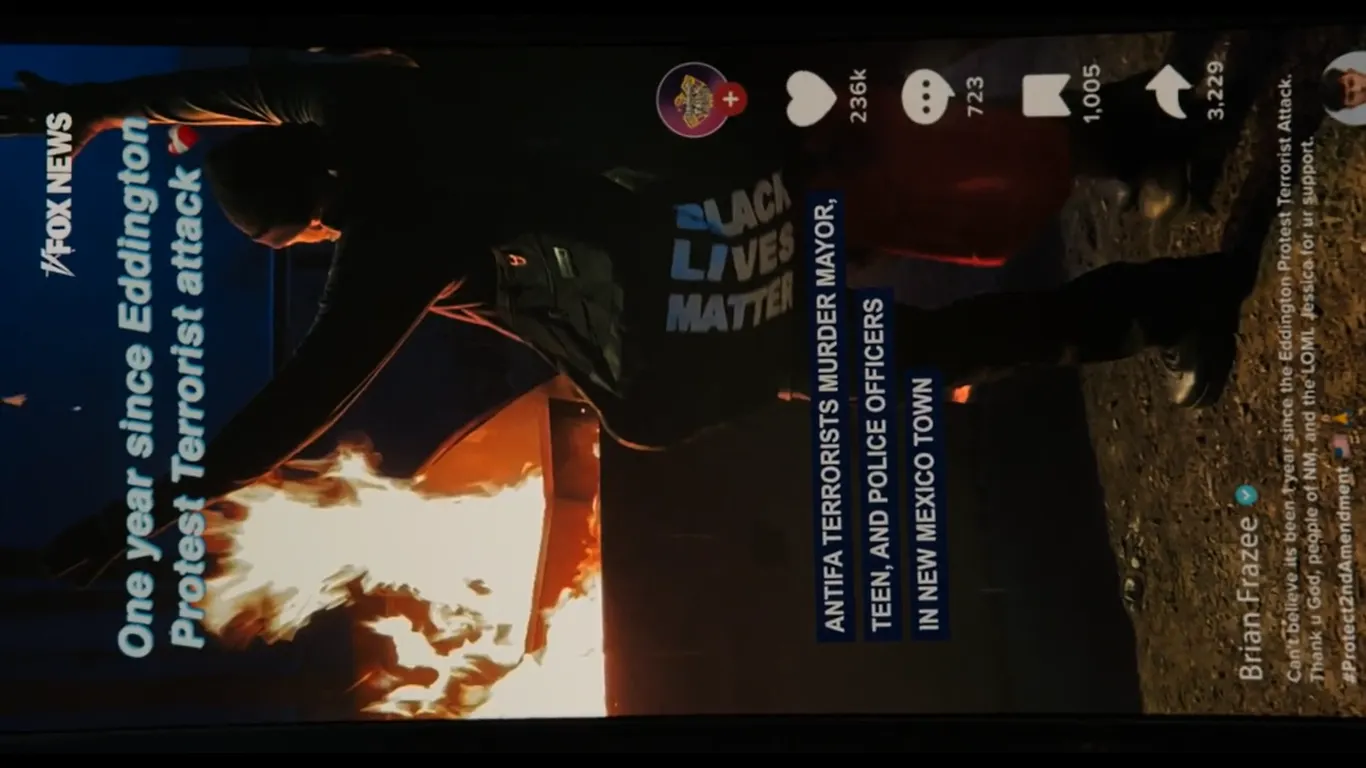
And no, it does not in a way resemble the perfectly natural cycle of denial-anger-bargaining-depression-acceptance which would nonetheless be inappropriate for a man most of them have never met (a man who also denounced the very concept of empathy as something worth holding). The anger is so blatantly rooted in ideology. We have gone, in just over 48 hours, from the right assuming his killer was a transgender agent sent by no one other than ANTIFA (poignant, if you look at the frame from Eddington below) to the assumption that they’re at the very least a Democrat supporter to the assumption (now that the killer has presumedly been caught (a white, straight, cisgender man who grew up around guns within a Republican household) that he must’ve been brainwashed somewhere along the line during his one-semester go at a tertiary education (the right vehemently despise colleges).
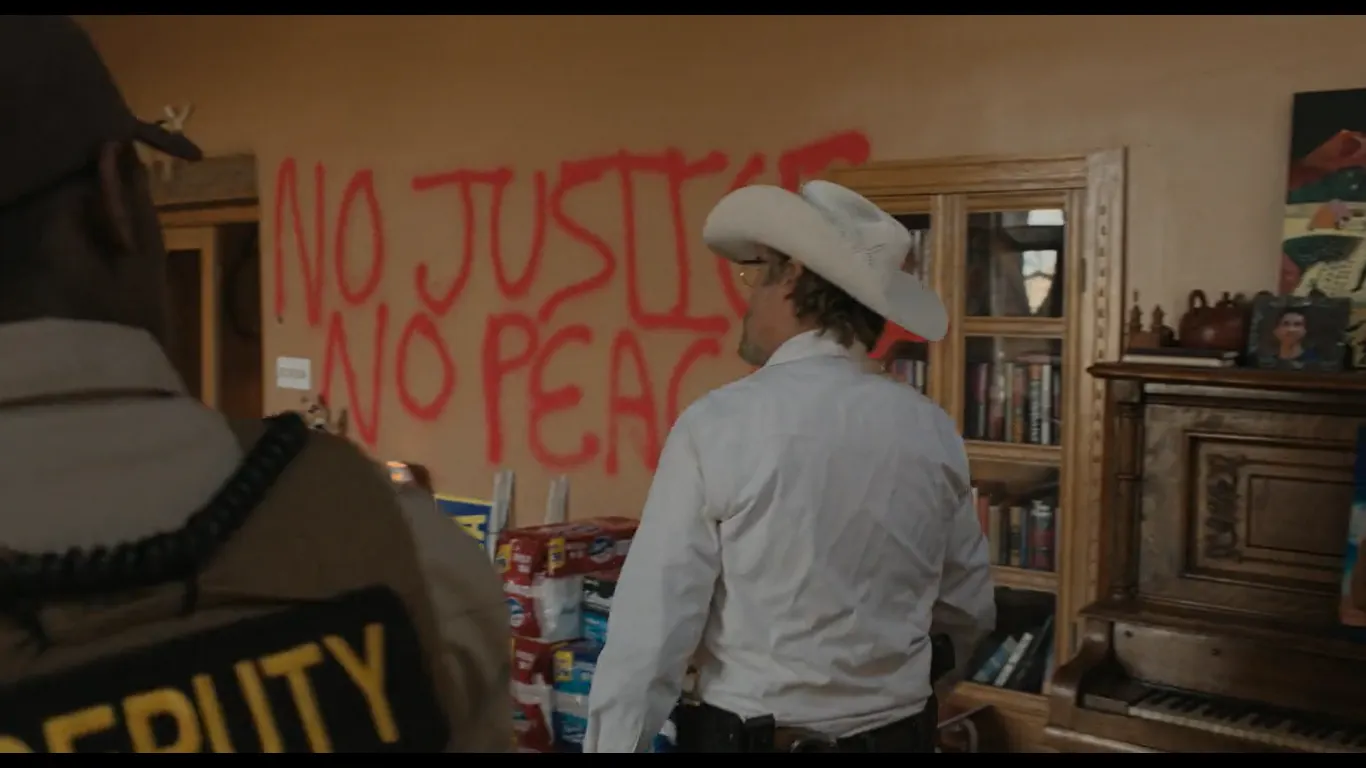
The assumption also arose about a few inscriptions on his artillery (which were nothing more than meme quotes I’m not too bothered to recapture here) that the right interpreted as leftist dog-whistles though not through sheer naivety. Similarly, in another scene in Eddington, Joe covers up his murder of Ted Garcia by spraying protest slogans over his living room walls.
The parallels between these past two days and this film don’t end there, but I would like to add a large asterisks mark. Now, I don’t think a film is inherently valuable or even “good” because it accurately prophecizes what comes after its own creation (even then, Eddington is not prophetic in any significant way; America has been like this for years, and this phase of pointed bloodlust towards anything deemed “woke” (especially after an act of political violence) happens every month, it does need not a genius to realize this) and so this is not a form of praise towards the film. Similarly, on a whole other note, you should only praise something like The Simpsons because it’s funny, and not because it keeps predicting an array of pop culture moments.
Rather, I wanted to point out that Eddington acts more like a benchmark on this long, twisting, eternally changing flight up the stairs of history. I do have to give Ari Aster props for even having a swing at a concept that is, at its core, so contemporary (placing it within the lockdown era already ages it upon arrival). I enjoyed it more than my friend’s viewing not because I found it profound (at this point, I have to accept that Aster isn’t exactly a man with a “thesis” (even Hereditary lost its footing once it delved into a subject slightly more intellectual than that of grief (which was witchcraft, a topic you don’t need much logic to integrate it with)) but he is a proficient master at portraying how inconsolably weird everything is.
Without much of a political thesis (at least one that takes any side) he is still able to point a viewfinder from the top-down, into how life moves “within” our post-truth political environment. Without getting into how we got here (and honestly, we have to ask if such an ask is too naive to bring upon the medium of narrative film, there might be at best a handful of films that I could stamp onto with the verification of a proficient, in-depth political thesis (and I already presented most of those films last month for our “Solidarity Movie Months” (if you weren’t there, it’s really tough to be you)) Aster still holds a strong bearing on where we are.

The truth has been de-prioritized to the point where it acts more of a hindrance within current political debates than a goal (think of how futile it has been running up towards conservatives and Zionists with statistics and information on daily death tolls and over-bloated military spending receipts) and every major political event receives proclamation as the long-awaited spark for civil war. Social media and its unending stream has, in fact, not turned every major event into something infinitesimal and instead everything has grown gargantuan yet short lived. Cycles of discourse lead to topics of varying importance and effect to hold equal space on one stage within an undying festival, noise, nonsensical farce and numb overstimulation. The world has gone beyond satire, maybe we could have said that back in 2016. This is the New Normal, in more ways than one. In more ways that we can even keep track of. All of this can be read in reference to Eddington or where we are in September of 2025; Eddington is a plot rather lived than simply watched.
We hope you enjoyed reading this take on an American film which veered into a critique of American society from the perspective of a mid-20s man in South Africa. If you want to read more unnecessary opinions, subscribe to our Substack! Weekly essays will be coming back as we get back into the groove.